
Stay Open: Art & Yoga
The first time art ever stopped me in my tracks was when I saw Alexander Calder’s “Red Polygons”. It was sometime in the 80’s. I was a teenager. I walked up the stairs of The Phillips Collection in Washington D.C. with my grandmother. Suspended from the ceiling above the stairs was the piece.
Silent.
Alexander Calder, Red Polygons, 1950
It moves effortlessly. Succumbing to patrons walking below it. Or as my friend, and fellow Yoga seeker, Zach and I found out last month when we visited the modern art museum, even blowing kisses in its direction can start the dance. The sheet metal plates and wire are painted red. Calder balances the weight and shape with precision to allow the open play with space and time.
Back then, this piece really changed my life.
Dramatic– I know. Especially since I seem to have so many lightning bolt moments that redirect me. No apologies though. I really was changed by this piece - by the mid-90’s I was installing my pre-graduation senior show “Feminism” from the ceiling in Olin Hall, the art gallery at my college.
I’m no longer sculpting - at least not with tangible materials.
In Yogic philosophy, it is understood that all this ‘doing’ and ‘playing with the things of the world’ is, in the long run, designed to set us free. It’s a whole thing. It is all laid out in the Sankhya Philosophy: Purusa (pure consciousness) interacts with Prakriti (all the stuff of life and this world). The experiences one has in life (Bhogha) exist specifically to be experienced and liberate us (Apavarga) so that we can recognize Purusa that has been unchanged all the while. [More on this in a future essay.]
When I learned this, it also changed my life.
I am still deep in this art; and Yoga is the science that generously provides the transformative structure. Here’s what I mean when I say Yoga is art & science.
Sometimes I realize that the experiences of life spin me around like a centrifuge - it’s easy for me to get excited and intense. Like right now: the caterpillars in my garden are making me lovesick and I can’t think straight about if I should watch them all day, move them to my porch to protect them, let them do their caterpillar thing etc. etc.
Other times I’m locked in and see clearly and communicate with ease. In those instances, things click and I can tell I’ve gotten out of my own way to let a greater plan work through me.
When I start to veer towards spinning out of control my teacher nudges me back to my Yoga practice (Sādhanā). I frequently have to reorganize my day to make this a priority. I have an ever evolving routine that doesn’t really have anything to do with my yoga mat or downward facing dog. [More on my personal Sādhanā in another essay.] Within an hour I have a new perspective… far enough away to see both clear lines and the potential for chaos.
So, last month, when I arrived for the Miró and The United States exhibit at The Phillips Collection, you better believe that this piece stopped me in my tracks.
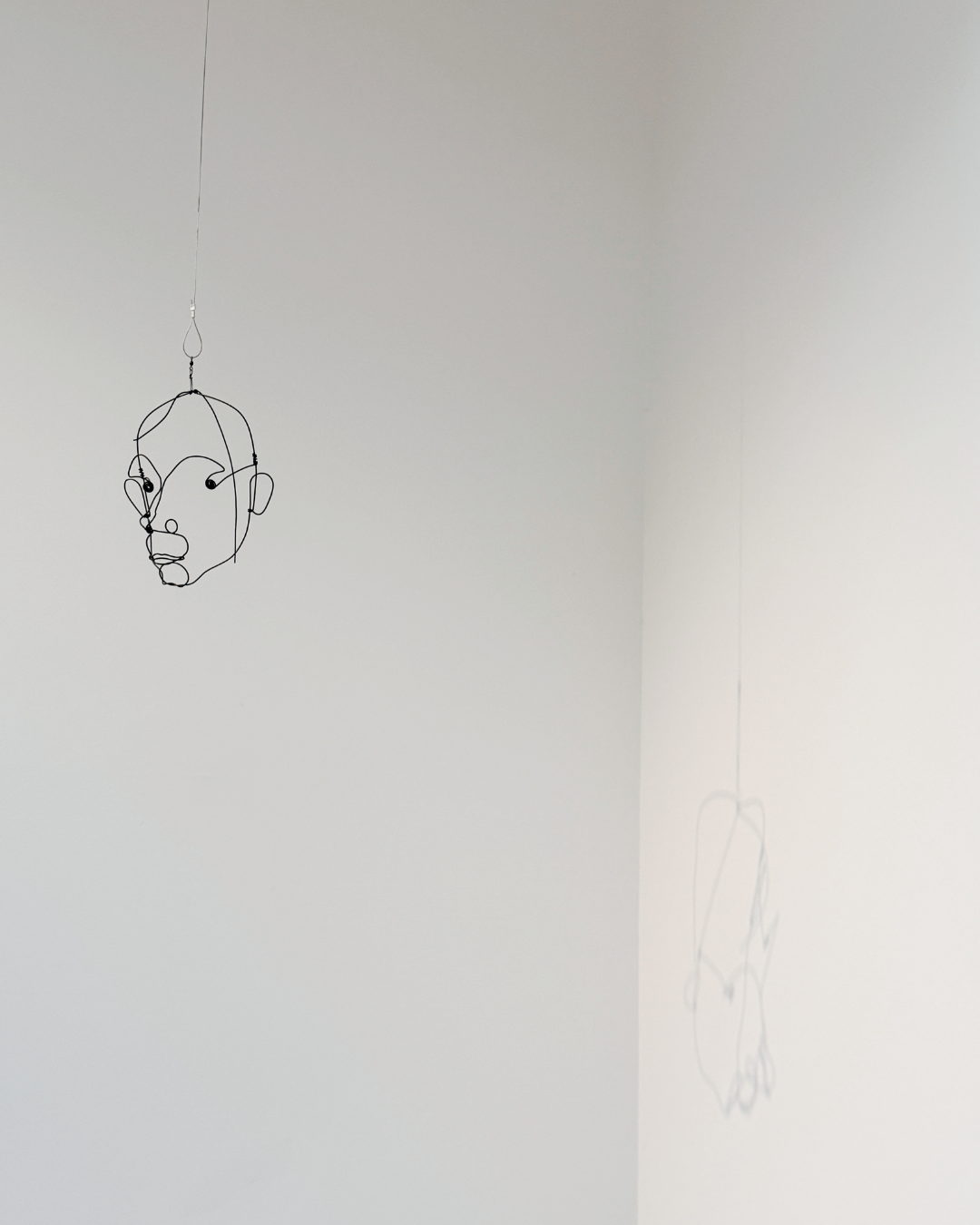
Alexander Calder, Portrait of Joan Miró, 1930
Calder’s wire portrait of his dear friend Joan Miró is hanging just opposite “Red Polygons” now. Of course the installation was spot on regarding the placement, the shadow, and the sharp re-entrant corner. How simple and clear. And look - those same lines are a jumbled scribble created by the interruption of light.
Isn’t that how it goes? We get too far from the truth and everything seems distorted.
Yet, the observer has the delight of both perspectives.
“If the interplay of lines and colors does not expose the inner drama of the creator, then it is nothing more than bourgeois entertainment. The forms expressed by an individual who is part of society must reveal the movement of a soul trying to escape the reality of the present… . in order to approach new realities, to offer men the possibility of rising above the present.” - Joan Miró
If you are familiar with these guys, you know that Calder and Miró had overlapped in their artistic interest and “fascination with cosmological relationships” (phillips.com). Through line, color, movement and negative space they changed the landscape of visual expression. And that, in my experience, sets in motion a change in everything
Arguably, “Constellations”, Miró’s 23 piece series painted during the early chaos of World War II is the most significant scope of his work. In a tumultuous time, this artist retreated perhaps for his own wellbeing, and as it turns out for a surrealistic breakthrough that defined the times.
“I closed myself within myself purposely. The night, music, and the stars began to play a major role in suggesting my paintings.” - Joan Miró
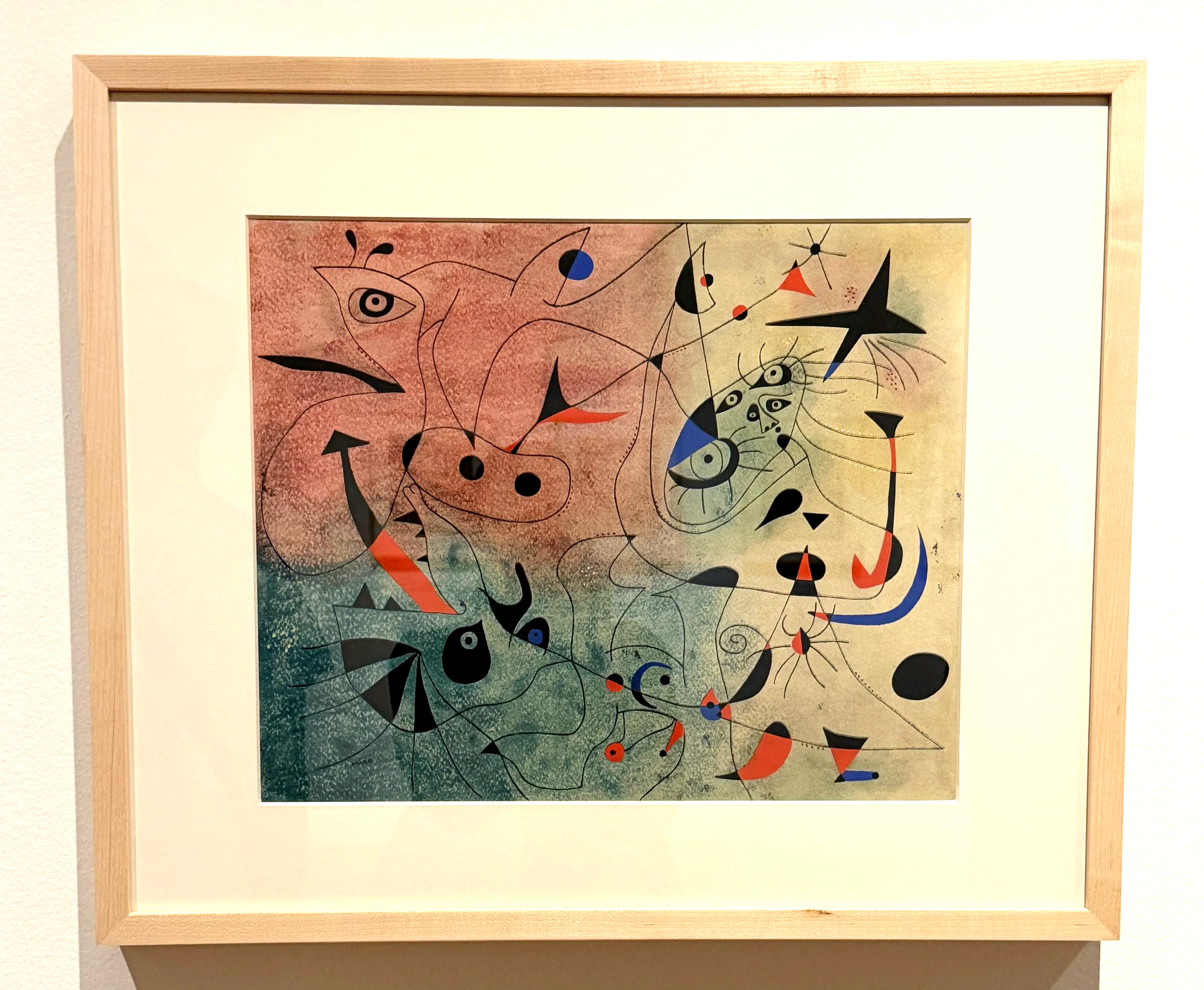
Joan Miró, Morning Star, 1939
Morning Star is one of the most important part of the series of 23, Miró was adamant about keeping his paintings with him at all times as without them his focus was disrupted and the genius of his expression interrupted. There was one exception, this… “Morning Star ” which Miro gave to his wife. She later donated it to be reunited with the complete set.
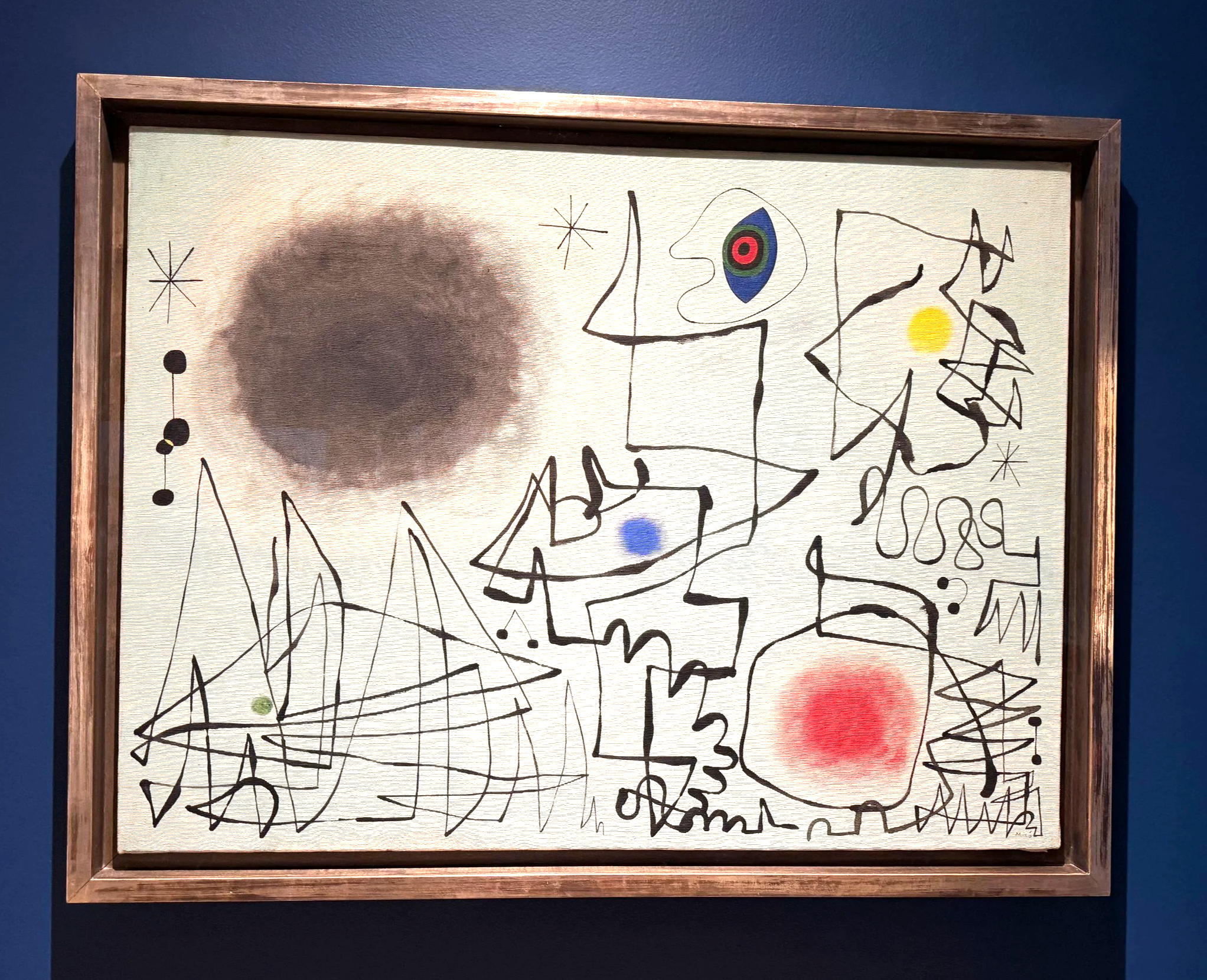
Joan Miró, Diamond Smiles at Twilight, 1948
Why I consider Miró and Calder my artistic heroes is how open they both stayed to allow their artistic expression to evolve. For goodness sake, way before his epic mobiles which now define grace and beauty, Calder’s early work “Cirque/Circus”, was a portable playset of wire forms that he would carry in a suitcase and set up at whim. Ha! A little on-demand circus. He would arrange them, animate them, create soundscapes even. Not a single thing about their art was status quo, convenient, or expected, but it was brilliant and necessary.
That’s a nod back to what it means to be an observer. At the end of the day that is what artists and scientists (and Yogis) do. Look. Jump in. Step out. Reflect. Revise. Start again.
Thank you for reading.